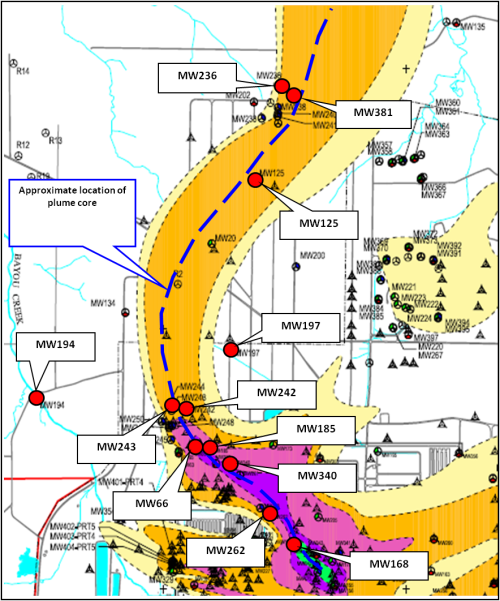
Adapted with permission from: Lee, Hope M., Looney, Brian B., Hampson, S.K. 2008. "Enzyme Activity Probe and Geochemical Assessment for Potential Aerobic Cometabolism of Trichloroethene in Groundwater of the Northwest Plume, Paducah Gaseous Diffusion Plant, Kentucky." WSRC-STI-2008-00309.
EMD Technology
Contacts
Blaine Rowley
U.S. Department of Energy
(301) 903-2777
M. Hope Lee
Pacific Northwest National Laboratory
( 240) 818-2987
Groundwater below a portion of Paducah Gaseous Diffusion Plant in Paducah Kentucky is contaminated with chlorinated solvents, primarily trichloroethene, TCE. TCE was first released to the subsurface as the result of site operations, which included disposal and burial of hazardous and radioactive materials across the site, from 1952 to the mid 90s (Lee et al. 2008b, p. 11). The dominant source of contamination at the site is associated with continued TCE and 99Tc releases in the vicinity of building 400. The site is the location of an old river bed and as such groundwater moves quickly, approximately 3 feet per day; site operations, and the local geology have resulted in two defined groundwater contaminant plumes, northwest and northeast, which originate near building 400 and end in tributaries off site. Other defined contaminant plumes (not considered in this study) exist on site and are associated with waste and burial grounds; all of the mentioned groundwater plumes share similar geochemistry and thus potential for attenuation of the contaminants under intrinsic conditions.
In 1997 Clausen et al. documented biological attenuation of chlorinated solvents in groundwater at the Paducah site; however the observed half-life degradation rates were estimated to be between 9.4 and 26.7 years. Based on the chemical and geochemical sampling results, the relatively slow rates of degradation, aerobic co-metabolism of TCE was suspected as the dominant mechanism for attenuation but was not confirmed in the study. At that time, the estimated rates were considered much too slow to accomplish site goals and no further studies were proposed.
Unlike reductive dechlorination of TCE under anaerobic conditions, where biological break-down products, such as 1-2, cis-dichloroethene or vinyl chloride are produced, degradation of TCE under aerobic conditions can only be inferred by indirect measures of carbon dioxide, disappearance of the contaminants, geochemical conditions (elevated dissolved oxygen and an appropriate carbon substrateAny substance that is acted upon by an enzyme.), and EMDs.
Enzyme Activity Probes (EAPs) were used to directly measure enzyme activityRefers to when a microorganism performs a specific function (e.g., sulfate reduction, metabolism of benzene) of target enzymesAny of numerous proteins or conjugated proteins produced by living organisms and facilitating biochemical reactions (based on USEPA 2004a). known to be produced during co-metabolic degradation of chlorinated solvents such as TCE.
EAPs directly measure if methane and/or aromatic (substrates such as toluene, benzene, phenol) enzyme production is occurring. These enzymes are documented to be produced for the degradation of methane and aromatic compounds and also break down TCE in a process referred to as co-metabolism (Lee et al. 2005, 2008a; Keener et al. 1998, 2001; Clingenpeel et al. 2005; Wymore et al. 2007; Miller et al. 2002).
For this study, the EAP results were compared to the following additional lines of evidence: (1) quantitative and traditional PCR for the genes of interest (oxygenases), (2) carbon stable isotopic analysis, (3) geochemical conditions, (4) contaminants trends, and (5) conservative tracers (99Tc).
Collectively, these additional lines of evidence were used to validate the EAPs as a useful tool for confirming the presence of co-metabolic processes and more importantly to confirm co-metabolic degradation of TCE was occurring in situ and at measurable rates at the Paducah site (Lee et al. 2008a).
An assessment was conducted to determine if EAPs could be used to confirm co-metabolic destruction of TCE. In this study, 12 wells were selected along the centerline of the northwest plume as well as two control wells outside the contaminant plume at the site. The wells are shown in Figure A.7-1.
Figure A.7-1: Map displaying wells where either sMMO enzyme-activity probe, and/or one or more toluene enzyme-activity probes were used.
Source: PRS, 2007; reprinted in Lee et al. 2008b.
As shown in Table A.7-1, positive results were established for both toluene oxygenases (9 out of 12 wells) and the soluble methane monooxygenase (sMMO) enzymes (7 out of 12 wells). Inhibitor studies supported these findings (data not shown). Quantitative toluene probe results represent the percentage of the total biomass determined to be active; values greater than 3% are considered significant.
|
Well |
Aquifer |
Screened interval depth (ft) |
TCE * (µg/L) |
Tc-99 (pCi/L) |
Qualitative preliminary data (6/4/7) |
Toluene probes quantitative data (% of Total DAPI) |
Total –DAPI cells/mL |
|||
|---|---|---|---|---|---|---|---|---|---|---|
|
|
|
|
|
|
sMMO probe Coumarin |
Toluene probes |
3HPA |
PA |
Cinnamo- nitrile |
|
|
1MW168 |
URGA |
63 - 68 |
10,000 to 100,000 |
3260 |
- |
- |
0.00 |
1.27 |
0.00 |
1.90E+05 |
|
MW66 |
55 - 60 |
1,000 to 10,000 |
3670 |
+ |
+++ |
3.90 |
5.73 |
2.49 |
3.67E+05 |
|
|
MW194 |
47 - 52 |
<MCL |
17 |
+ |
+++ |
1.78 |
5.41 |
6.80 |
1.76E+05 |
|
|
MW197 |
58 - 63 |
<MCL |
283 |
- |
+ |
1.09 |
3.95 |
0.14 |
1.59E+06 |
|
|
MW185 |
MRGA |
68 - 73 |
1,000 to 10,000 |
1260 |
- |
++ |
1.84 |
1.41 |
0.20 |
9.75E+05 |
|
MW242 |
65 - 75 |
100 to 1,000 |
341 |
- |
- |
0.46 |
0.16 |
1.14 |
7.76E+05 |
|
|
MW243 |
65 - 75 |
100 to 1,000 |
3860 |
- |
- |
0.77 |
1.08 |
0.31 |
4.27E+05 |
|
|
MW381 |
66 - 76 |
100 to 1,000 |
329 |
- |
++ |
6.36 |
3.64 |
0.57 |
9.66E+05 |
|
|
MW262 |
LRGA |
90 - 95 |
1,000 to 10,000 |
4178 |
+ |
+++ |
3.83 |
3.86 |
7.92 |
3.52E+05 |
|
MW340 |
85.5 - 95.3 |
1,000 to 10,000 |
747 |
+ |
+ |
0.05 |
1.32 |
0.00 |
7.25E+05 |
|
|
MW236 |
69.5 - 79.5 |
100 to 1,000 |
936 |
+ |
+++ |
3.66 |
5.95 |
1.05 |
8.84E+05 |
|
|
MW125 |
78 - 88 |
100 to 1,000 |
273 |
+ |
++ |
1.74 |
7.97 |
2.54 |
7.99E+05 |
|
|
ft bgs– feet below ground surface µg/L – micrograms per liter pCi/L – picocuries per liter cells/mL – per milliliter |
|||||||||
|
Sample ID |
δ13C (per mil) |
Comments |
|---|---|---|
|
Northwest plume wells along the flow path |
||
|
MW-168 |
-24.8 |
Near source |
|
MW-262 |
-25.8 |
|
|
MW-340 |
-25.9 |
|
|
MW-185 |
-25.9 |
|
|
MW-242 |
-24.6 |
|
|
MW-243 |
-25.3 |
|
|
MW-125 |
-25.6 |
|
|
MW-381 |
-25.4 |
|
|
MW-236 |
-25.3 |
Distal portion of plume |
|
MW-66 |
-25.3 |
Near downgradient source |
|
MW-197 |
-23.1 |
Control well, outside of plume |
Analytical costs associated with EMDs are included in Table A.7-3 below.
|
EMD |
No. of Samples |
Cost per Sample |
Total Cost |
|---|---|---|---|
|
EAP and PCR |
12 |
2700 |
$32,400 |
|
CSIA |
12 |
500 |
$ 6,000 |
|
Total |
|
|
$38,400 |
The technologies, CSIA, enzyme activity probes, and microcosmA sample that is regarded as a small but representative portion of something larger. In environmental studies microcosm are typically small samples of soil, sediment, or water incubated in enclosed containers under laboratory conditions. studies, were still in demonstration phase when applied at the Paducah site. A collaborative effort was undertaken to demonstrate the appropriate knowledge and understanding was in place prior to applying the technology which proved very successful for this site. Specific criteria were defined before a groundwater sample was taken and included the definition for success for any one of the technologies. As a result, the contractor, technical staff, and regulators all agreed prior to data collection, what would be deemed sufficient evidence for aerobic co-metabolism to be a significant process within the sampled groundwater plume.
While there was a large amount of historical and current groundwater monitoring data including contaminant concentrations and a range of geochemical parameters, many of the aerobic biological indicators were not known or previously measured. A large effort was undertaken by the site in collaboration with the state and federal regulators to determine the appropriate geochemical parameters to be measured in support of aerobic degradation of chlorinated solvents. During the investigation it was also determined that the method for determining oxygen concentrations in groundwater had been changed several times over the past decade, and more importantly the regulators were not confident in the methods used. Working with the site contractor, a more robust method (time and expense) was used to monitor oxygen concentrations throughout several groundwater plumes at the site. It was also concluded that there were insufficient developed wells within the predominant groundwater plume and the DOE along with the site, installed 75 new MW locations across the site in order to better monitor groundwater and in order to develop a more complete conceptual site model.
Clausen, J.L. N.C. Sturchio, L.J. Heraty, L. Huang, T. Abrajano. 1997. "Evaluation of Natural attenuation processes for trichloroethylene and technetium-99 in the northeast and northwest plumes at the Paducah Gaseous Diffusion Plant, Paducah, Kentucky." Lockheed Martin, for the Department of Energy. KY/EM-113.
Clingenpeel, S.R., Keener, W.K., Keller, C.R., De Jesus, K., Howard, M.H., and Watwood, M.E. 2005. "Activity-dependent fluorescent labeling of bacterial cells expressing the TOL pathway." Journal of Microbiological Methods 60:41-46. PMID 15567223.
Keener, W. K., M. E. Watwood, and W. A. Apel. 1998. "Activity-dependent fluorescent labeling of bacteria that degrade toluene 2,3-dioxygenase." Applied and Environmental Microbiology 49:455-462.
Keener, W. K., M. E. Watwood, K. D. Schaller, M. R. Walton, J. K. Partin, W. A. Smith, and S. R. Clingenpeel. 2001. "Use of selective inhibitors and chromogenic substrates to differentiate bacteria based on toluene oxygenase activity." J. Microb. Meth. 46:171-185.
Lee, M.H., S.C. Clingenpeel, O.P. Leiser, and M.E. Watwood. 2005. Molecular and Physiological Characterization of Aerobic TCE Degradation Potential. Eighth International In Situ and On-Site Bioremediation Symposium. Battelle Press, Columbus, OH.
Lee, M.H., S.C. Clingenpeel, O.P. Leiser, R.A. Wymore, K.S.Sorenson, Jr., and M.E. Watwood 2008a. "Activity-Dependent Labeling of Oxygenase Enzymes in a Trichloroethene-Contaminated Groundwater Site." Environmental Pollution 153:238-246.
Lee, Hope M., Looney, Brian B., Hampson, S.K. 2008b. "Enzyme Activity Probe and Geochemical Assessment for Potential Aerobic Cometabolism of Trichloroethene in Groundwater of the Northwest Plume, Paducah Gaseous Diffusion Plant, Kentucky." WSRC-STI-2008-00309.
Miller, A.R., W.K. Keener, M.E. Watwood, and , F. Roberto. 2002. "A rapid fluorescence-based assay for detecting soluble methane monooxygenase." Applied Microbiology and Biotechnology 58:183-188. PMID 11876411.
PRS, 2007. Tricholorethene and Technetium-99 Contamination in the Regional Gravel Aquifer for the Calendar Year 2005, Paducah Gaseous Diffusion Plant, Paducah, Kentucky, PRS/Project/0019.
Wymore, R.A., M.H. Lee, A.R. Miller, W.K. Keener, F.S. Colwell, M.E. Watwood, and K.S. Sorenson, Jr. 2007. "Field Evidence for Intrinsic Aerobic Chlorinated Ethene Cometabolism by Methanotrophs Expressing sMMO." Bioremediation Journal 11(3):125-139